








In this article, we explore five Japanese kigo (season words) that serve as keys to summer poetry.
we all find ourselves lingering somewhere between heaven and earth - gazing up at the drifting clouds, then looking down at the grass and tiny insects beneath our feet.















01

Sultriness
impermanence
Intensity


the right part - an element that historically meant "to shake" or "to make a loud sound"
the left part - insect
The Japanese word "semi" itself is simply an abbreviation of the ancient "sen-mushi" (the insect that goes "sen-sen").
In ancient Japan, it was believed that the large cicada chirps "sen-sen"
The kanji cicada consists of two parts:


The cicada is a Buddhist symbol of the impermanence of the world (mujo).
This insect spends long years( sometimes up to 17 years!) in total darkness underground. But once it comes out into the light, dries its wings in the sun, and finds its magnificent voice, the cicada lives for only a few short weeks. Its fierce, loud song is more than just a mating call. It is an anthem to the finality of existence, a manifesto of a life that burns brightly but burns out in an instant.
To listen to the cicadas is an attempt to catch the exact second when life overflows, knowing that very soon, this music will fade, giving way to the autumn chill.
This insect spends long years( sometimes up to 17 years!) in total darkness underground. But once it comes out into the light, dries its wings in the sun, and finds its magnificent voice, the cicada lives for only a few short weeks. Its fierce, loud song is more than just a mating call. It is an anthem to the finality of existence, a manifesto of a life that burns brightly but burns out in an instant.
To listen to the cicadas is an attempt to catch the exact second when life overflows, knowing that very soon, this music will fade, giving way to the autumn chill.




there is a beautiful idiom - Semi-shigure (蝉時雨), which literally translates to 'a downpour of cicada voices.'
It evokes the image of a continuous hum that crashes down upon you in a bamboo grove or at the foot of a mountain temple.
This sound so completely fills the entire space that, paradoxically, it burns away all mental noise, leaving the author alone with pure being.
It evokes the image of a continuous hum that crashes down upon you in a bamboo grove or at the foot of a mountain temple.
This sound so completely fills the entire space that, paradoxically, it burns away all mental noise, leaving the author alone with pure being.
In Japanese poetry,
In the traditional Japanese calendar, the word 'Cicada' is a synonym for the absolute, dazzling peak of summer - when the sun freezes at its zenith, and the air gets so thick with heat that it feels tangible.

閑さや岩にしみ入る蝉の声
Shizukasa ya / iwa ni shimiiru / semi no koe





The poem was composed at the Yamadera mountain temple (officially known as Risshaku-ji) in modern-day Yamagata Prefecture
Basho wrote this poem in the summer during his famous journey, documented in his travel diary Oku no Hosomichi (The Narrow Road to the Deep North)



Yamadera Temple is an ancient Buddhist monastery literally carved into the steep cliffs of Yamagata Prefecture. For over a thousand years, it has served as a sanctuary for hermits seeking solitude among the clouds and centuries-old cedars. Its informal name, Yamadera, translates simply as the 'Mountain Temple'





The higher you climb, the more the world changes around you.
Let's read this poem closely and look at it in more detail.
In modern Japan, the Ministry of the Environment made an official list called '100 Soundscapes of Japan'. These are sounds of nature and culture that the government protects from city noise. The singing of cicadas at Yamadera Temple has an honorable place on this list. If you are lucky enough to visit this temple one day, you will hear exactly what Basho heard in 1689. Modern civilization could not quiet this 'voice'. It is a real time machine.
And in summer, among the ancient pines and very old stones, there was only one sound. It was the loud, vibrating cry of unseen cicadas. The sound was so clean and strong that the rocks did not reflect it. Instead, they absorbed it like a sponge, making the place feel even more timeless and still. Basho wrote his poem in this exact atmosphere.
The slopes of Yamadera are made of unusual gray rocks. The wind and rain changed these rocks over time, creating many small caves. Stone statues of Buddhas hide inside them like little mountain spirits.
The atmosphere of Yamadera is a pure, real feeling of timelessness. The mountain welcomes the traveler with a deep, holy peace that washes away all worldly worries.













Basho describes the loud sound of cicadas as a real, physical thing that flows into the holes of granite and stone. The sound gets weight and density, and the stone becomes soft.
The word 'shimiiru' (to soak into or absorb) is usually used for liquids.
For example, how ink goes into paper or water goes into dry earth.
For example, how ink goes into paper or water goes into dry earth.






Perhaps the poet himself felt like a part of this huge universe while staying at the Yamadera temple.
In the very end, he focuses on a tiny, almost invisible cicada that is part of this huge universe.
Then, he looks at the huge rock.
First, he shows us the whole big world around (the silence).
The poet moves the camera closer, just like in a movie.
is a symbol of eternity, total stillness, hardness, and change. In Basho’s moment of clarity, these two extremes - the quick sound of a bug and the eternal rock - become one. One goes inside the other, erasing the line between what is temporary and what is eternal.
is a symbol of extreme fragility and a short life. It lives underground for several years. But when it comes out, it sings and dies in just a few weeks. Its voice is a song of moments that quickly pass



Become an invisible explorer! Your task is to find any tiny creature - an insect, a snail, or a little spider - and write a haiku about it.
Imagine this little bug is your friend. Where does it live? What is around it? What is it doing and why? Is it thinking about something? How does it make you feel? Are the two of you alike in any way?
Or maybe you can even capture the sound the bug makes through the words of your haiku, just like the great Basho did?
Imagine this little bug is your friend. Where does it live? What is around it? What is it doing and why? Is it thinking about something? How does it make you feel? Are the two of you alike in any way?
Or maybe you can even capture the sound the bug makes through the words of your haiku, just like the great Basho did?
Connect things that seem incompatible in just three lines (like Basho’s fragile cicada and eternal rock).
Choose two opposite words. For example: ice and fire, noise and silence, old age and youth, iron and a tender petal.
Try to catch a moment in nature where they meet. Pay close attention to the world around you, and you will surely notice something you have never seen before—like a green vine wrapping around a rusty nail in a fence, or hot tea cooling down on a winter windowsill.
Express your discovery in 3 lines.
Choose two opposite words. For example: ice and fire, noise and silence, old age and youth, iron and a tender petal.
Try to catch a moment in nature where they meet. Pay close attention to the world around you, and you will surely notice something you have never seen before—like a green vine wrapping around a rusty nail in a fence, or hot tea cooling down on a winter windowsill.
Express your discovery in 3 lines.
Remember or imagine a place where you feel endless peace – nature, home, or a café. Try to express this feeling in a 3-line haiku.
The Harmony of Opposites
3
2
1
In Search of Tiny Worlds
Feel the peace
In these 17 syllables, there is a huge concentration of hissing (S, Z) and shushing (SH) sounds. They sound just like real cicadas! When we say this haiku out loud, it feels like we become that very cicada ourselves.

PRACTICE






Pure
Subtle
DIVINE




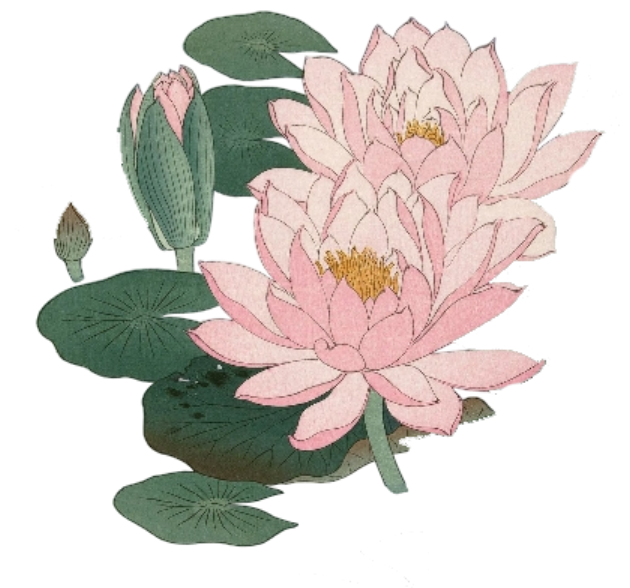
In haiku, the lotus often brings an atmosphere of peace, holiness, and calm in the middle of the hot summer.
the flower is born in the muddy water of swamps and ponds. But it grows through it and opens under the sun, completely clean and perfect.
Lotus became the main symbol of
The lotus is deeply connected to Buddhism.









To enjoy lotuses, Japanese people organize morning picnics (hasumi).
It is an amazing feeling- to wake up with the first rays of the sun, when the city is still asleep, and go to a temple to watch the lotus open.
Lotuses open in the middle of summer strictly at dawn (between 5 and 6 AM) and close by noon



A huge pond full of lotuses and the ancient Seijo-no-taki waterfall - the oldest stone waterfall in Japan - create a feeling of total peace and freedom from the world.
The central part of the temple is a walking garden. It was built in the 12th century during the Heian period for Empress Taikenmon-in. The garden was designed as an earthly copy of Buddhist paradise (Amida's Pure Land).
Hokongo-in is a quiet Buddhist temple in the west of Kyoto. It is also called 'The Lotus Temple' as it is one of the most authentic places in Japan to look at these amazing flowers.
Natsume Sōseki
Honobono to / fune oshidasu ya / hasu no naka
ほのぼのと舟押し出すや蓮の中




Kude Beach, Wakasa Province by Hasui Kawase
PRACTICE
2
1
My Name is Flower
From Dusk till Dawn
Take a stroll through a park or visit a botanical garden.
Find that one single flower about which you can boldly say, "This is me." Why this specific flower? (Is it standing proudly alone, hiding in the shade of big trees, or blooming wildly against all odds?) What trait do you share? (Tousled petals, a strong stem, a delicate color, or perhaps sharp thorns?) Which mood of this flower matches your internal state right now?
Write your haiku in the first person, as if you are this flower telling the world about its life.
Find that one single flower about which you can boldly say, "This is me." Why this specific flower? (Is it standing proudly alone, hiding in the shade of big trees, or blooming wildly against all odds?) What trait do you share? (Tousled petals, a strong stem, a delicate color, or perhaps sharp thorns?) Which mood of this flower matches your internal state right now?
Write your haiku in the first person, as if you are this flower telling the world about its life.
Take a summer walk at sunrise or sunset and look closely at the world around you.
What interesting flower will you cross paths with as the sun rises or sets? What scents surround you? What color has the sky become? Where did the very last (or the very first) ray of sunlight fall? What feelings does this scene evoke? What interesting everyday things are happening at this exact moment?
write down your notes and shape this flow into a 3-line haiku.
What interesting flower will you cross paths with as the sun rises or sets? What scents surround you? What color has the sky become? Where did the very last (or the very first) ray of sunlight fall? What feelings does this scene evoke? What interesting everyday things are happening at this exact moment?
write down your notes and shape this flow into a 3-line haiku.
Even today in Japan, you can actually ride a boat right through the blooming lotuses. This tradition is called "Hasumibune" (蓮見舟), which literally means "lotus-viewing boat." For example, at Lakes Izunuma and Uchinuma in Miyagi Prefecture, the water is almost completely covered by a carpet of pink flowers in summer. There, you can take a boat deep into the thick patches of blossoms and experience the world of the ancient haiku firsthand
This creates a cinematic effect: the world wakes up in two directions at once. Light slowly comes down from above, while the boat moves forward, cutting through the lotuses.
Right then, the boat moves- oshidasu -as someone pushes it into the water.
shows the very early dawn. The night is still dark, but the eastern sky is just starting to turn gray or white. It feels completely quiet and mysterious.
the haiku begins with a fascinating word:









03
Mystical
Fleeting
Obscure

it was seen as a sign of taste to
bird
time/season
The kanji used to write the word 'cuckoo' literally translate to 'bird of time' or 'bird of seasons.'
in the old days, people waited for its very first call of the year (hatsune) with excitement.
The cuckoo flies in from the south and announces the arrival of summer in Japan.







Matsuo Basho
Hototogisu / Ōtakeyabu wo / Moru tsukiyo
時鳥大竹藪をもる月夜




By applying it to moonlight, the poet turns the night into a tangible, liquid substance.
Usually, this word is used for liquids, like a leaking roof or water drops.
The verb moru means "to ooze" or "to leak."
The sound literally creates light.
Through this gap, the moonlight begins to pour.
PRACTICE
1
2
Voices in the Leaves
Birdsong Symphony
Listen closely to the birds around you- whether you are in a park, out in nature, or in the city. Choose the one you like the most, and pay attention not only to its voice but also to what surrounds it at that exact moment.
Where is the bird hiding? (In the dense branches of a tree, on top of an old pole, or in a thicket of reeds?)
What is happening around it? (Is moonlit light leaking through the leaves, is the wind rustling, or is warm rain falling?)
How does its voice change the space? (Does it suddenly pierce the silence, or does it fade into the city noise?)
Try to catch the contrast between the bird and the world around it, and express it in a 3-line haiku.
Where is the bird hiding? (In the dense branches of a tree, on top of an old pole, or in a thicket of reeds?)
What is happening around it? (Is moonlit light leaking through the leaves, is the wind rustling, or is warm rain falling?)
How does its voice change the space? (Does it suddenly pierce the silence, or does it fade into the city noise?)
Try to catch the contrast between the bird and the world around it, and express it in a 3-line haiku.
Listen closely to the birds singing around you - whether you are in a park, out in nature, or in the middle of the city. Notice the interesting details of their voices and behavior.
write a haiku about the bird that you liked the most.
write a haiku about the bird that you liked the most.
However, it seems to pierce a gap in the thick wall of the forest.
The bird's cry is physically invisible.







Dreamy
Silent
Glowing

The two main types of fireflies in Japan are named after warring samurai clans:
In Japan, their soft, glowing greenish light in the dark is connected with fleeting beauty, secret dates, and the souls of ancestors
The firefly is the most romantic and mystic image among summer words.




(smaller, with fast blinking)
If you find yourself in Japan in summer and spot some fireflies, look closely and try to tell the Genji apart from the Heike. In that very moment, you will feel as if you have been transported to an ancient samurai time.
Japanese people believed that the ghostly souls of fallen warriors met in the night to continue their ancient medieval war.
When thousands of fireflies gather over the water in early summer, this phenomenon is called Hotaru Gassen (蛍合戦) - "The Battle of Fireflies”
(large, with a strong green glow)




The Iya Valley is one of the most isolated and mysterious places in Japan, often called the "inner secret" of Shikoku Island. Because of the steep cliffs and thick fogs, the atmosphere of ancient legends has been preserved here for centuries.
The famous Hotaru-no-sato (ほたるの里) nature park is located in the Iya Valley on Shikoku Island (Tokushima Prefecture, Miyoshi City).
If regular Japanese summer festivals make you think of noisy dances, loud shouts of sellers, and the roar of fireworks, Hotaru Matsuri is the exact opposite. It is a festival of absolute silence, coolness, and watching the darkness.
It is a special joy to visit Hotaru Matsuri (蛍祭り ) - the Firefly Festival.


The main rules of the festival are complete darkness and silence. Visitors are asked to turn off phone screens, flashlights, and camera flashes. In this atmosphere, the big city disappears, and people dive into pure nature.













ほたる飛や家路にかへる蜆売








Suzuki Kiitsu
Seashells and Plums19th century
Seashells and Plums19th century
The surrounding nature seems to come alive, lighting hundreds of tiny "lanterns" to illuminate the path for this poor, exhausted man. There are no deep philosophical themes in this haiku, yet it holds a profound empathy and warmth.
Buson shows that nature is equally generous with its beauty to both the emperor and the simple clam vendor.
The fireflies seem to take the man under their wing. In the gathering dusk, their gentle lights brighten the poor man's road, transforming his heavy, mundane journey home into a magical, almost sacred procession.
This man is incredibly tired. His workday is over, and he is trudging home. The exact moment when the first fireflies rise above the evening paths and rice fields Synchronizes with the vendor returning to his hut. Darkness falls.
They spent the entire day on their feet, bent double, gathering shells from the freezing waters of streams or standing in the markets.
Buson, a genius painter, crafts this haiku like a canvas where every everyday detail matters. In the Edo period, vendors of shijimi river clams were among the poorest merchants.




PRACTICE
Painting with Words
Write a haiku as if you are painting a picture
Imagine your pen is an artist's brush. Choose a palette and a subject.
Set the background, the movement in the foreground, and a sharp color accent.
Imagine your pen is an artist's brush. Choose a palette and a subject.
Set the background, the movement in the foreground, and a sharp color accent.





Serene
Vivid
Graceful






In Japan,
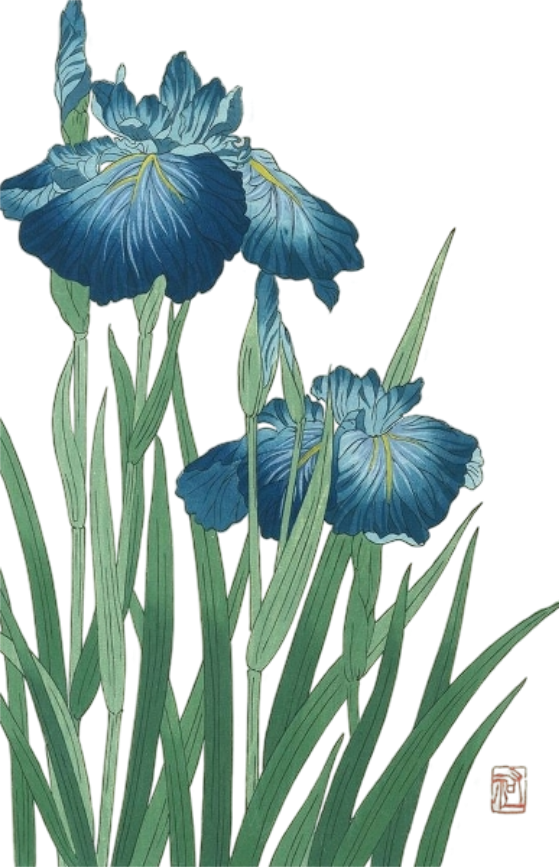
Even today, looking at a vast sea of blue, purple, and white irises swaying over cool, calm waters in a gentle breeze brings an incredible sense of mental freshness and peace.
The arrival of the rainy season (tsuyu) and the suffocating heat caused food to spoil instantly, sparked epidemics, and left people feeling weak. Ancient Japanese believed that evil spirits and demons (oni) were behind all these troubles.
summer was traditionally seen as the most dangerous time of the year.


The long, stiff, and sharp leaves of sweet flag and iris look exactly like Japanese swords. Because of this blade-like shape and their sharp, fresh, spicy scent, these plants were believed to hold magical powers. In early summer, during the Tango no Sekku festival, people decorated their roofs and gates with bunches of these "green swords" to block demons from entering their homes.

















The first syllables of the street’s name (Aya...) perfectly echo the word for iris (Ayame)
Early morning is arriving. The city is still asleep. The first pale rays of the sun begin to light up the roofs in the Patterned Lane (Aya-no-Koji).
The scene takes place in the early morning of the Boys' Festival (the Iris Festival). On this day, following an old tradition, the people of Kyoto decorated the roofs and eaves of their houses with the long leaves of the shobu iris (sweet flag)
He mentions Ayanokoji- a famous, narrow historic street in Kyoto.
Seira builds this haiku on a graceful play on words and meanings that was deeply loved in Kyoto.



PRACTICE
Wordplay
For example, "iris" in English is not only a flower but also the iris of the eye.
Write a haiku with a hidden pun or wordplay, inspired by Seira’s wordplay on the iris (Ayame) and the alley (Aya-no-koji)