















Back in 12th-to-14th-century Japan, aristocrats and poets did not just drink tea or wine when they gathered - they played high-stakes literary games.
Their favorite pastime was a game called Renga (literally, "linked verse").
Their favorite pastime was a game called Renga (literally, "linked verse").
But the true story of Japan’s most famous poetic form actually begins in a very different setting. It started not in quiet isolation, but at loud, competitive, and highly aristocratic parties.


(01)


This process went around in a circle, and these poetic chains were massive- sometimes stretching to exactly 100 stanzas. It required immense wit, speed, and deep literary knowledge to keep the chain going without breaking the rhythm
A third person would build on that response with another three lines, and so on.
The next person had to instantly respond by adding a two-line resolution.
The first person would compose a three-line riddle or opening stanza to set the theme.
You can think of Renga as a medieval precursor to (a modern rap battle) a collaborative poetry jam. It was a group effort with very specific rules:






Haiku
Hokku
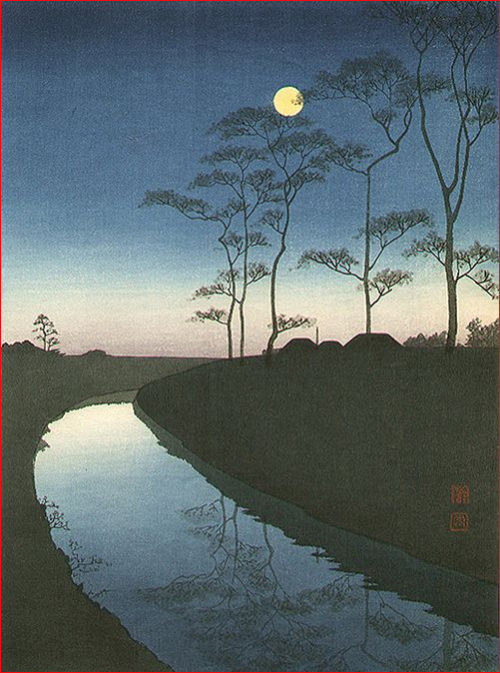
町中を行川音の月
村雨に / 市のかりやを / 吹とりて
青き覆盆子を / こぼす椎の葉
秣おふ / 人を枝折の / 夏野哉
Machinaka o yuku / kawaoto no tsuki
Murasame ni / ichi no kariya o / fukitorite
Aoki ichigo o / kobosu shii no ha
Magusa ou / hito o shiori no / natsuno kana
Renga is not just an ancient art; it is an exciting workout for your mind and imagination.
Imagine yourself in a cozy wooden hut, sitting among the poets of the past.
Try turning on your 'inner director' and continue this poetic chain (or start your own, inspired by whatever surrounds you right now!).
Feel free to control the camera: use close-ups, narrow your focus down to a tiny detail, abruptly shift the scenery, or change the perspective completely.
Imagine yourself in a cozy wooden hut, sitting among the poets of the past.
Try turning on your 'inner director' and continue this poetic chain (or start your own, inspired by whatever surrounds you right now!).
Feel free to control the camera: use close-ups, narrow your focus down to a tiny detail, abruptly shift the scenery, or change the perspective completely.
There is also a deep Buddhist meaning here: the busy market represents Ukiyo (the fleeting human world), while the moon and river symbolize eternal nature. In Japan, a summer shower (murasame) is a force that washes away the heavy heat and dust. The rain leaves the night air crystal-clear, making the moon shine incredibly bright. This image gives the reader a real feeling of coolness and relief after a hot, exhausting day.
Bashō masterfully uses contrast. He replaces the noise and panic of the market with the calm, steady sound of the Naka River in Kurobane, swollen by the rain. The flying straw and storm clouds vanish, replaced by the still, pure light of the night moon.
The imagery in the fourth stanza perfectly shows Bashō’s genius and the rules of renga. After the previous poet brought chaos with a wild storm at the market, Bashō had to restore harmony. By the rules, you cannot add more destruction; you must balance it with peace.
The third poet abruptly shifts the imagery, making a classic renga 'leap': from a quiet forest path with berries, he transports us to a bustling village market. In the midst of the summer heat, a sudden thunderstorm with squalling winds (murasame) strikes, tearing the thatched roofs off the market stalls.
The second poet takes up the theme of this meadow and field. He narrows the scale, bringing the reader's gaze closer to the very ground. He imagines that the peasant, or perhaps a passing child, gathered these not-yet-ripe, sour summer berries deep in the forest, wrapped them in freshly plucked leaves of a broad-leaved chinquapin oak, but accidentally spilled them right into the grass underfootith grass on a summer afternoon. The grass is so high that the path is hidden from view, and one can only navigate by following the figure of a peasant carrying a huge bundle of mown grass on his back.
Bashō describes a vast summer field overgrown with grass on a summer afternoon. The grass is so high that the path is hidden from view, and one can only navigate by following the figure of a peasant carrying a huge bundle of mown grass on his back.
A summer evening. The scent of fresh tatami mats fills the cozy wooden house. Outside, the sweltering day is fading, and the poets decide to play renga - weaving their thoughts into a single poetic chain. The great wanderer Matsuo Bashō composes the opening stanza, the hokku. Before his eyes, there still stands the endless meadow, overgrown with tall grass, which they had crossed along the way
Over time, poets grew so tired of writing endless chains that they said: "Why don't we let the first stanza (hokku) become an independent poem? It is already perfect on its own." This is how hokku broke away and transformed into what we know today as Haiku.
The very first, starting stanza in this chain was called Hokku. literally, "initial verses." It had to be the most vivid, set the tone, and strictly indicate the season and the place where everyone had gathered.









Practice









(02)
He traveled thousands of miles, slept in tiny huts, spent nights under the open stars, and constantly risked his life on dangerous mountain passes. His poetry wasn't born from books; it was born from the dirt, the rain, and the road.
At the height of his fame, he grew restless with the comfortable, crowded life in the capital city of Edo (modern-day Tokyo). He walked away from it all. Packing only a walking stick, a straw hat, and a small pack, he set off on foot across the wild, rugged terrain of 17th-century Japan.
Basho was not a sheltered academic writing from the comfort of a luxurious estate. He was a wanderer.
Before Basho, haiku (or hokku, as it was still called) was mostly seen as a witty, humorous pastime. Basho took this lighthearted game and transformed it into a profound philosophy and a high art form.
If the medieval aristocrats created the engine of haiku, it was one man in the 17th century who gave it a soul. His name was Matsuo Basho (松尾 芭蕉), and he became the ultimate master of the genre.

The core philosophy that Basho brought to haiku was the concept of Satori (悟り) - a sudden flash of spiritual enlightenment.
Basho completely flipped this tradition on its head.
To Basho, the entire purpose of a haiku was to capture a single, fleeting moment of ordinary life so perfectly that it reveals a deeper, universal truth. He proved that you don't need grand words to touch the sublime; you just need to open your eyes to the magic of the everyday world.
Before Basho, traditional Japanese poets only wrote about grandiose, epic subjects: Imperial courts and royal tragedies, Legendary battles and heroic samurai
Basho traveled to clear his mind and to learn a completely new way of seeing the world. He wanted to find "the divine in the ordinary."




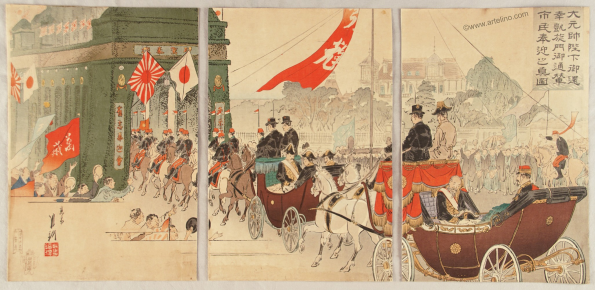

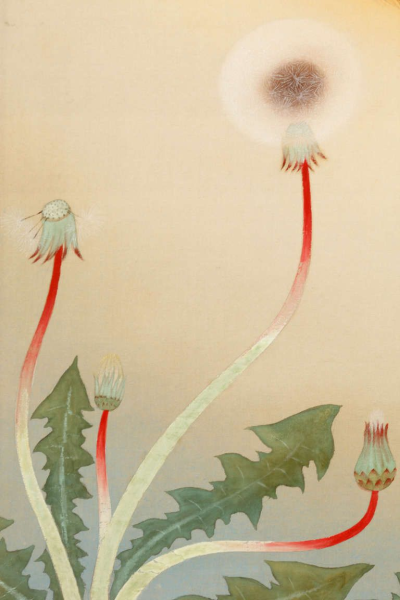


meiji
Then came a young, bold journalist named Masaoka Shiki (正岡 子規). He looked at the traditional poetry of his time and decided it was time for a revolution.
It was Shiki who completed the final, ultimate evolution of the form.
Practice
Write a few lines about what surrounds you right now
Under Shiki’s influence, haiku transformed into a literary snapshot. He normalized writing about the prose of modern everyday life. For the first time, haiku began to feature steam trains, glass windows, smoking factory chimneys, and ordinary street food.
To mark this new era, he renamed the genre Haiku. Every time we use the word "haiku" today, we are directly quoting Masaoka Shiki.
Shiki was a rebel with a pen. He felt that poetry should reflect this dynamic new world, not the distant past. He openly attacked the traditional establishment, declaring that old-school poetry had become artificial, boring, and obsolete.
Shiki lived during the Meiji Restoration - a chaotic, exciting era of rapid modernization. Japan, after two centuries of isolation, suddenly opened its doors to the Western world. Steam trains, telegraph lines, European fashion, and photography flooded the country.
By the late 19th century, the art of hokku was dying. What Matsuo Basho had turned into a profound philosophy had slowly degenerated back into a rigid, lifeless academic exercise. The poetic scene had become an exclusive "old men's club" where writers did nothing but make pale copies of Basho's work, strictly following ancient templates.

(03)




Traditional haiku is always presented in a 3-line format
Practice
Write 3 lines about anything
It acts as a visual anchor. The three-line layout forces the human brain to process the thought in three distinct beats. There is no rhyme in haiku- in the Japanese language, rhyming sounds cliché and weak. Instead, the entire structure relies solely on the internal rhythm of the lines.
The first thing anyone notices about a haiku is its appearance. It is a masterpiece of minimalism, built on a strict architectural design.
ACTION
ACTION
SETTING
(04)

1
5
4
3
2
1
7
6
5
4
3
2
1
5
4
3
2
It is an excellent trainer for the brain and discipline. You have to select words like pieces of a puzzle.
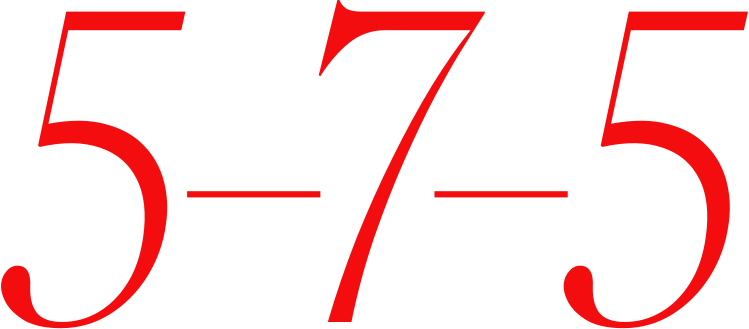
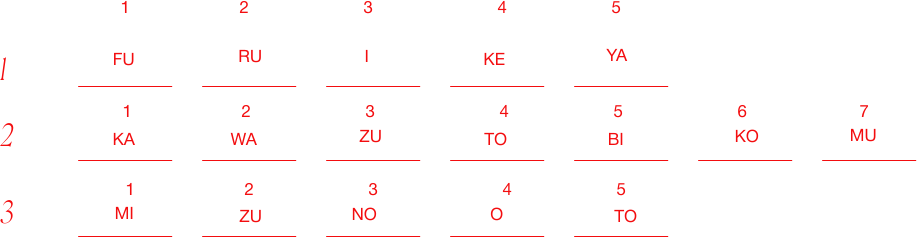
A traditional haiku must fit entirely into just three lines with a total of 17 syllables, broken down into a strict 5-7-5 pattern
There is a golden rule known around the world: a haiku must strictly follow a 5-7-5 syllable pattern.
Translation:
Old pond
(Matsuo Basho)
water sounds.
水の音
a frog leaps in,
蛙飛び込む
古池や







To save the spirit of haiku, modern international poets have broken the literal 5-7-5 rule.
syllables
Instead of counting exactly 17 heavy syllables, they now aim for a 10-to-14 syllable range spread across three short lines.
If you can read the whole haiku effortlessly in one breath, you have captured its truest essence.
Because an English syllable is much longer, heavier, and carries significantly more information than a Japanese onji, a strict 575 English poem inevitably becomes too clunky and slow.
However, the Japanese language is structured completely differently from English, which is why the traditional math of poetry often fails in translation. In Japanese, poets do not count syllables. Instead, they count onji, which are tiny, lightning-fast phonetic sound units
syllables
syllables
water sounds
a frog leaps in
Practice
Write your 3 lines using the 10-14 syllable formula
The low yellow
moon above the
Quiet lamplit house.
moon above the
Quiet lamplit house.
(03)
(02)
(01)
(03)
(02)
(01)
Old pond


Now, let’s talk about something much more beautiful
No more math!




(05)
By using these ancient, pre-coded natural symbols, a haiku writer manages to pack an immense amount of environmental context into a tiny space

The kigo establishes an unspoken contract between the poet and the reader, ensuring they are both standing in the exact same landscape, breathing the exact same seasonal air.
The word frog acts as an instant shortcut for the reader's imagination, bringing with it a whole atmosphere of melting snow, fresh mud, and awakening nature without wasting a single line on descriptive prose.
For example, in Matsuo Basho’s legendary verse about the old pond, the word frog immediately establishes the season as spring, because that is the exact time of year when these creatures wake up and become active.
Instead of explicitly telling the reader that a scene takes place during a hot July afternoon or a chilly November morning, a master poet uses kigo as a subtle visual and emotional trigger.
It is not just a technical rule; it is a secret key to understanding how the Japanese view existence. To them, humanity is never separated from nature.


























Practice
A sudden morning frost -
the wild path turns white beneath my sandals.
the wild path turns white beneath my sandals.
answers
1 - Autumn (kigo - withered branch)
2 - Summer (cicadas)
3 - Winter (frost)
1 - Autumn (kigo - withered branch)
2 - Summer (cicadas)
3 - Winter (frost)
Suddenly awake -
the deep, echoing chorus
of the cicadas.
the deep, echoing chorus
of the cicadas.
A solitary crow
perched on a withered branch -
the twilight fades.
perched on a withered branch -
the twilight fades.
(03)
(02)
(01)
What does the rain sound like?
How does the air change?
How does a summer rain differ in sensation from a spring rain?
What other interesting details can you notice about summer rain?
How does the air change?
How does a summer rain differ in sensation from a spring rain?
What other interesting details can you notice about summer rain?
How does the rain alter the visual world? (Does it instantly wash away the dust to make the foliage look "neon"? Does it turn a gray road into a glossy mirror?)
Write a haiku using the kigo "summer rain"
Think about the following details:

Rewrite this scenario into a modern 10-to-14 syllable haiku using Setting + Action structure. don't use the words hot, summer, afternoon, sitting, or tree. Use a summer kigo (like green leaves, heavy dust, or cicadas) to make the reader feel the heat instead of reading about it.
Take the following plain, boring sentence: “It is a very hot summer afternoon, and I am sitting under a tree.”
Stop using direct seasonal labels and start using evocative imagery.
Read the three haiku translations below. None of them use the words "spring," "summer," "autumn," or "winter." Your task is to act as a literary detective: identify the kigo word in each poem and determine exactly what season the poet is capturing.


Part 3 of the course is coming out very soon, where we’ll dive deeper into the nuances of writing haiku! Stay tuned to our social media and website

